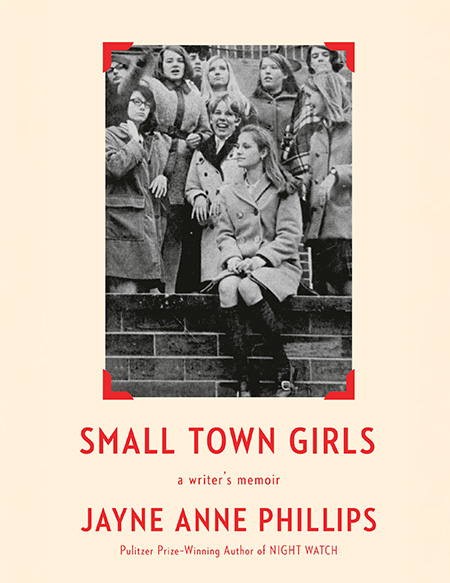
PRE-ORDER NOW
Alternative Covers
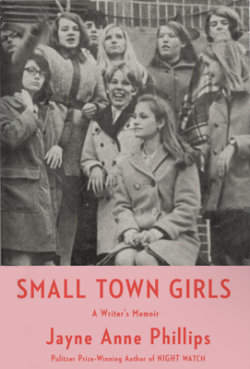
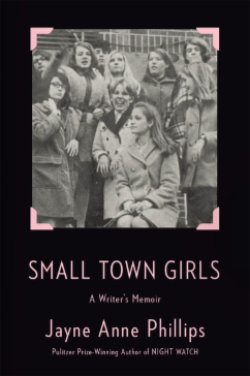
The great designers at Knopf engaged me in long conversation about colors and fonts for the lovely cover of SMALL TOWN GIRLS. The considered covers, below, are wonderful in themselves.
Foreign Editions
WINNER OF THE 2024 PULITZER PRIZE FOR FICTION
Small Town Girls
OPRAH’S #1 MOST ANTICIPATED BOOK OF 2026
“The painful thing about adolescence is that everything seems absolute, and the painful thing about adulthood is that nothing does.”
Jayne Anne Phillips grew up in the small town of Buckhannon, West Virginia. The distinctly American landscape of Appalachia—dense with forests and small churches, rich in history and misunderstandings—has been the great setting for her fiction, even as she and her boundless imagination have traveled to other times and places. In these pieces, and in her inimitable first-person voice, at once intimate and wide-ranging, Phillips brings us into her childhood and family, most movingly her mother. She recreates the place she calls home, its foundational truths and the densely woven ties between the women of the town. She traces her journey across the country in search of love and work and belonging—her discovery of writing and reading as tools for both survival and revelation—and offers insights into the fellow writers and touchstones that moved and influenced her. From the local beauty salon to the legendary Hatfield–McCoy feud, from Jean Shrimpton and Barbara Stanwyck to Stephen Crane and Breece D’J Pancake, Phillips ponders her relationship with inspiration, spirituality, culture, and the troubled annals of the last American centuries.
Tender, inviting, sparkling with wisdom and open-heartedness, Small Town Girls is part coming-of-age story, part social history, Jayne Anne Phillips’s most personal, most accessible book yet—a love letter to the place and the people who have shaped her perceptions and her writing.
Praise & Reviews
“Pulitzer-winning novelist Phillips (Night Watch) takes a lyrical look at her West Virginia upbringing in this wonderful memoir-in-essays. Born in 1952 in the small college and mining town of Buckhannon, Phillips muses that the area’s “long history and layered stories provided the perfect birthplace for a writer.” In “Premature Burial,” she juxtaposes the world of the movies, where life is “more the way [it] should be,” with the “grinding, entrenched poverty” in early 1960s Buckhannon. In “Outlaw Heart,” she ponders the distance between her mother, who longed to leave the town, and her resentful father. Elsewhere, Phillips reflects on important touchstones in her early life (“On Not Having a Daughter” details the abortion she underwent at age 20), and nods to her literary inspirations, including Red Badge of Courage author Stephen Crane, who portrayed the “ ‘familiar and low’ as lives that formed and commented on America as it truly was,” and fellow West Virginian Breece D’J Pancake, who sketched the “loss and wrenching cruelty” of life in Appalachia. Equal parts wistful and pragmatic, Phillips’s autopsy of rural mid-century America doubles as a haunting and insightful self-portrait. Even readers unfamiliar with the author’s fiction will be riveted.”
–Publisher’s Weekly
“A brilliant, wide-ranging book, nostalgic and tough-minded at the same time. Like Willa Cather and Stephen Crane, Jayne Anne Phillips writes prose that reads like plainspoken poetry, full of startling and vivid images that bring a vanished world back to life before our eyes.” —Tom Perrotta
“Phillips’ prose is unflagging in its beauty and rhythm, and the memoir leaning pieces have a special glow, infused with her profound nostalgia for her Appalachian childhood . . . . An essay devoted to refuting Kenneth Tynan’s assertion that writers hate to write contains an encomium to the novelist’s labor that begins like this: “We might compare getting started on a story to starting a relationship (oh, that first-time together, lying down skin to skin!), or beginning a novel to committing to a marriage. Each long-term liaison is laden with its own miracles and traps: there is the young marriage, the second marriage, the late marriage in which indolent time does not exist and all is revealed at the first touch.” Buy the book to read the rest of this paragraph alone …West Virginia has no more eloquent and grateful daughter. Boy, can she write.”–Kirkus Reviews
“I have long tried to avoid labeling someone a “writer’s writer” but based on the number of wonderful writers who’ve “confessed” to me their love of her short stories (and novels), I’d have to give that title to Jayne Anne Phillips ( with the very best of intentions, of course). And now we are blessed with her memoir, which follows her journey from a childhood in rural West Virginia to her discovery of writing and the eventual life in letters it gave her (with a cameo from another “writer’s writer, fellow West Virginian Breece D’J Pancake). As in her fiction, one can expect closely observed revelation, both intimate and expansive, delivered in that wry and open-hearted voice so beloved by so many.”–Lit Hub (Most Anticipated)
“ In not so much a conventional memoir as a collection of essays, novelist Phillips (Night Watch, 2023) ranges through significant moments in her life and muses on less personal but equally revealing topics. She recalls a mystical experience in church as a preschooler, remembers weekly visits to a hair salon with her mother as a child, and revisits with affection the dogs in her life. But Phillips also writes about the feud between the Hatfields and McCoys, her admiration for the fiction of Stephen Crane, and one of her favorite childhood television shows, The Big Valley. Motherhood and daughterhood recur as themes throughout the book in wrenching recollections of an abortion and of caring for a dying mother who was “enormously frustrated by dependence.” Together, Phillips’ essays treat the reader to a mosaic of her voices: humorous, scholarly, pensive, nostalgic. A sparkling introduction to the author for those who don’t know her, and a peek behind the scenes of her life for those who do.”–Booklist